
Home /
Home /
At the Montreal Real Estate Forum, MASSIVart joined a panel titled The future of retail: experience vs. convenience, bringing together voices from development, leasing, market analysis, and customer experience to look at how retail is evolving in practice.
Moderated by Manon Larose (Oberfeld Snowcap), the discussion featured Jordan Katz (Brasswater), Laurent Paquin (PMML), Stéphanie Roy (Carbonleo), and Claire Tousignant (MASSIVart).
The conversation focused on how consumer expectations are shifting, and what that means for how retail and mixed-use environments are being planned, financed, and operated.
One idea came up consistently throughout the discussion: performance is increasingly tied to whether people choose to spend time in a place.
Spending patterns are evolving, with more emphasis placed on how time is used rather than what is purchased.
This shift is already visible in how people move through retail environments.
Places that feel interchangeable or purely transactional continue to generate traffic, but they tend to see shorter visits and less engagement. People come with a purpose and leave once that purpose is fulfilled.
Shorter visits limit opportunities for tenants, reduce cross-shopping, and make it harder for a site to build any form of loyalty.
That shows up in:
Over time, places that fail to hold attention become easier to replace.
This shift is already influencing how projects are being repositioned.
Across Quebec, retail environments are being densified, with large parking areas gradually converted into residential and mixed-use components. This adds activity and strengthens fundamentals, but density alone does not guarantee performance.
What matters is how these different uses connect, and whether the site offers enough depth to keep people on-site longer.
Without that, even well-located assets struggle to differentiate and compete beyond convenience.
Density can support performance, but it does not replace experience. Without depth, connection, and reasons to stay, density alone has limited impact.
The discussion around experience focused less on activations and more on behaviour.
Stéphanie Roy shared observations from benchmarking work across North America and Europe, highlighting environments where people consistently spend more time than expected.
These places tend to create conditions where visitors naturally slow down, even in otherwise fast-paced contexts.
What drives that behaviour is rarely a single feature. It is the result of multiple layers working together.
At ROYALMOUNT, this translates into a more integrated approach.
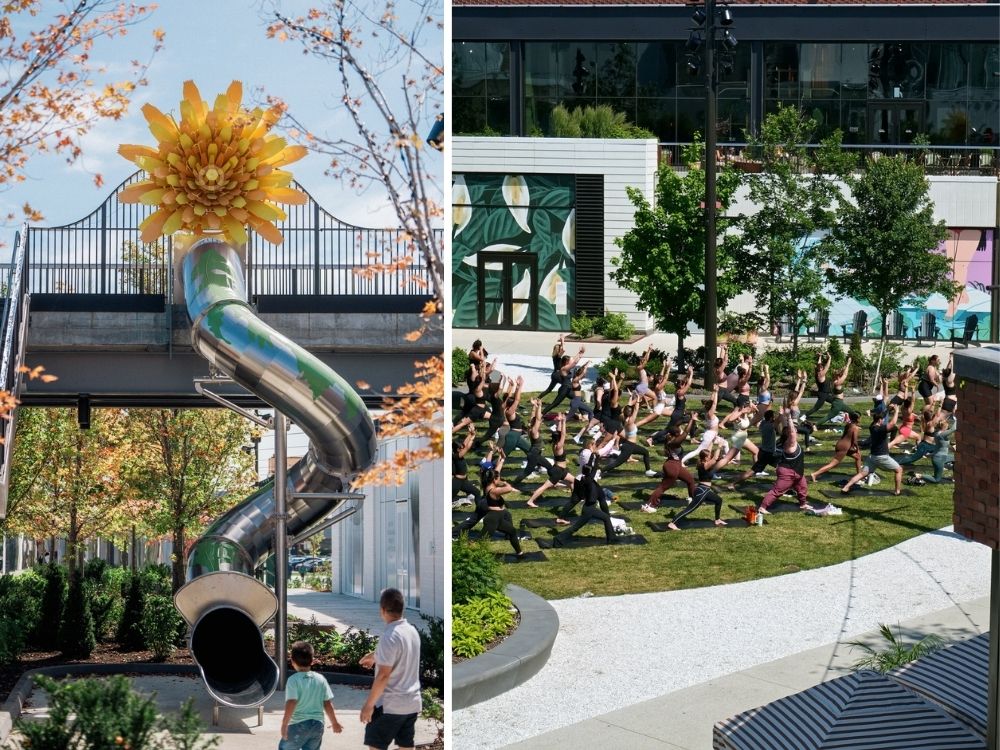
Public art is embedded within circulation paths, creating natural moments of pause. Soundscapes evolve throughout the day, subtly influencing the rhythm of the space. The site is designed to support both everyday use and larger-scale events, allowing the experience to shift depending on the moment.
These decisions shape how people move, how long they stay, and whether they choose to come back.
The impact becomes visible in performance, through longer visits, stronger tenant engagement, and more repeat activity.
Similar patterns can be observed in developments by Caruso in Los Angeles, where retail, hospitality, and public space are closely integrated. These environments are designed to support longer, more frequent visits, creating conditions that benefit tenants well beyond one-time transactions.
What also came through clearly is that experience does not stop at design.
The way a place is operated plays a significant role in how it performs over time. Programming, partnerships, and ongoing curation all contribute to keeping the environment active and relevant.
Operational teams are adapting to this reality. In some cases, this includes using tools such as AI to streamline internal processes and allow teams to focus more on the on-site experience, particularly in how they interact with tenants and visitors.
A successful retail or mixed-use environment is not one that peaks at opening. It is one that continues to evolve, adapt, and remain relevant as behaviours and expectations shift.
Another recurring point was the number of disciplines involved in shaping these environments.
From early-stage analysis and land acquisition to leasing, design, and operations, each layer influences how the place ultimately performs.
These functions are often managed separately, each with its own objectives and timelines.
Creating a cohesive environment requires aligning these decisions around a shared understanding of how the place is meant to be experienced.
That alignment rarely happens on its own. It needs to be structured early and carried through the lifecycle of the project.
A place-led approach helps bring continuity, ensuring that experience is not treated as an overlay, but as a driver of how the asset performs.
For developers, this shift changes how long-term performance is approached.
Delivering a project that meets current expectations is no longer sufficient on its own. Behaviour is evolving, and the environments being built today will need to remain relevant well beyond their initial launch.
Projects that sustain their value tend to be those that account for that from the beginning, by creating environments that continue to engage over time and adapt as expectations shift.
In practice, this becomes a way to de-risk performance across the lifecycle of the asset.
Over time, the gap becomes visible in how people use the space.
Some environments continue to attract, retain, and evolve with their users. Others lose relevance as quickly as they can be replaced.
That difference is not accidental.
It comes down to whether the experience has been intentionally designed, curated, and maintained over time.