Home /
Home /
For Contre-jour, Espace pour la vie – Biosphère wanted to test a different way of activating one of Montréal’s most recognizable cultural landmarks and bringing new audiences into the site.
MASSIVart was brought in to study the opportunity, develop the concept and artistic direction, curate the programming, and produce the pilot.
The first edition reached full capacity, generated a waitlist exceeding 200% of event capacity, achieved a 93% attendance rate, and brought a significant share of first-time visitors to the Biosphère.
The Biosphère already has unusually strong assets: Buckminster Fuller’s geodesic dome, panoramic views over Montréal, its setting within Parc Jean-Drapeau, and a museum dedicated to environmental issues.
The opportunity was to use those assets differently.
Before developing the program, MASSIVart studied comparable cultural experiences in Montréal and internationally, met with stakeholders and event experts, and analyzed how visitors could move through and use the Biosphère’s different spaces.
That research shaped the format of Contre-jour.
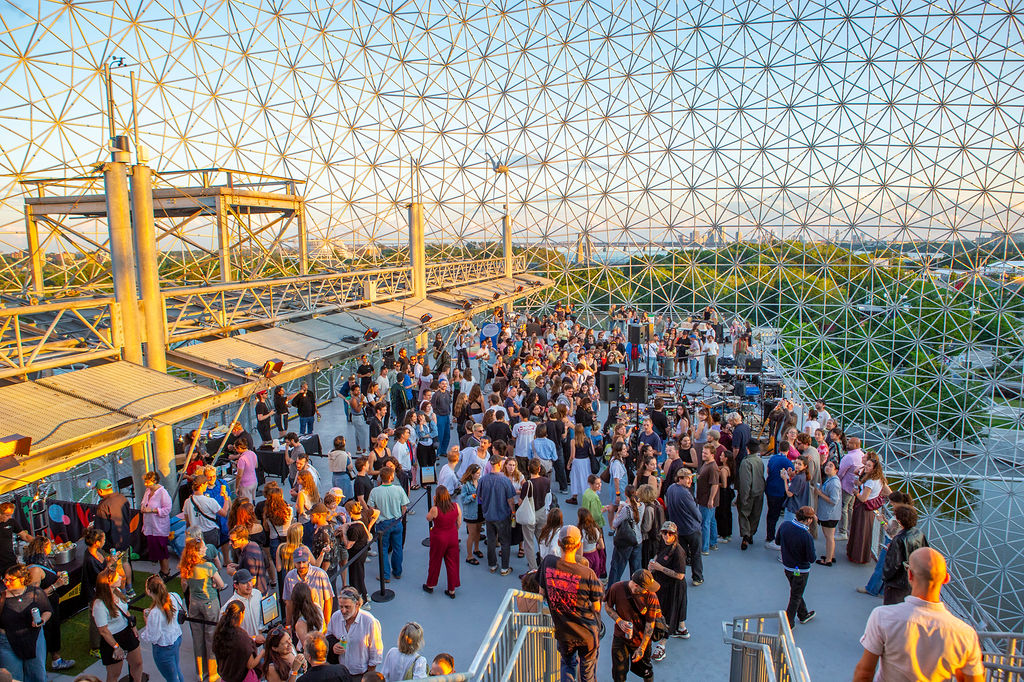
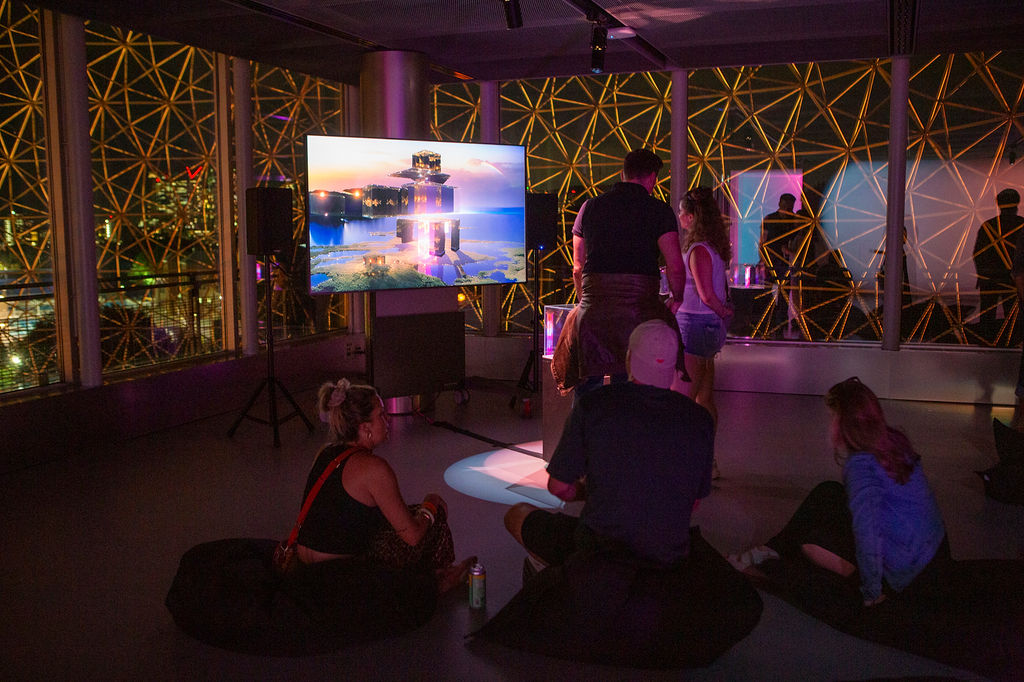
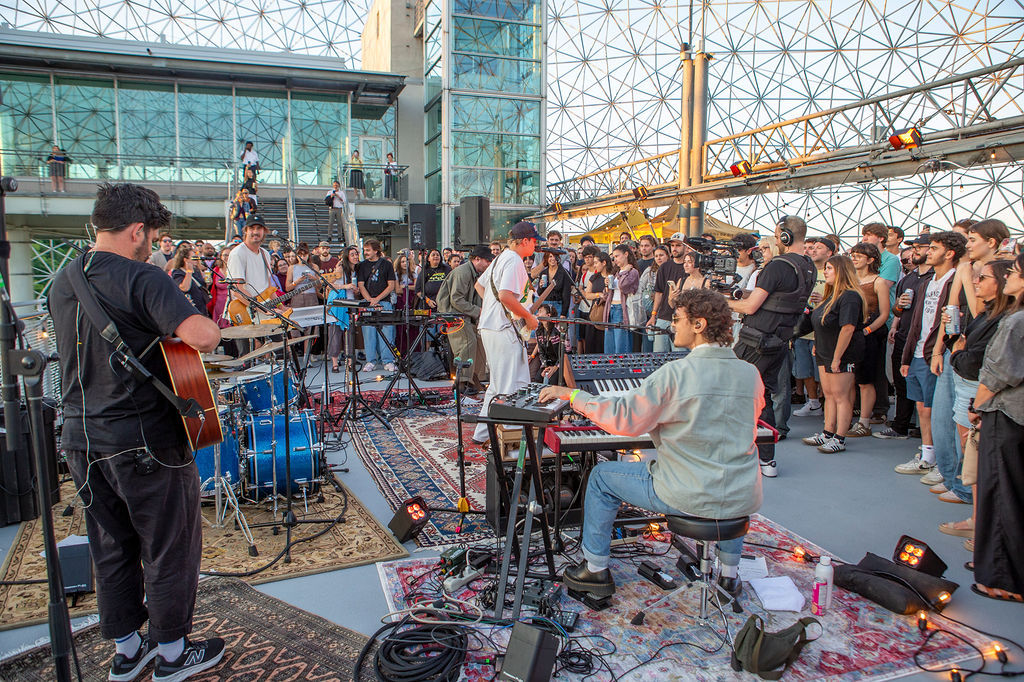
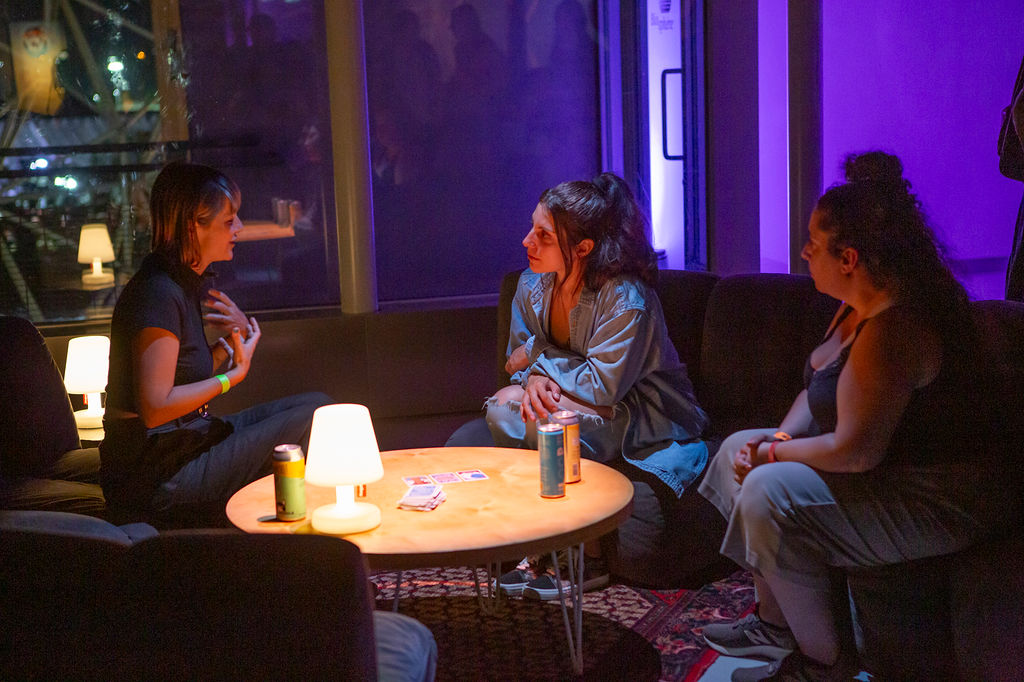
The belvedere became an intimate outdoor listening space. Interior rooms introduced another pace and another way of encountering art. Scenography remained deliberately restrained so that the architecture, landscape and changing light could carry much of the experience.
On August 19, Les Louanges performed on the belvedere as the sun went down.
Montréal collective Ferias played vinyl sets before and after the concert. Inside the Biosphère, visitors encountered an installation by Sabrina Ratté and dreamachine by Charline Dally and Estelle Schorpp.
The timing of the performance, the size of the audience, the movement between indoor and outdoor spaces, and the choice to keep the setup relatively light were all part of the concept.
Post-event research confirmed the role of the setting itself. After Les Louanges, the exceptional character of the Biosphère and its belvedere was the second most cited reason for attending. Visitors repeatedly mentioned the sunset, view, atmosphere and intimate scale among the elements they valued most.
The event reached full capacity. Before additional tickets were released, the waitlist had already exceeded 200% of the event’s total capacity.
Demand carried through to the event itself, which achieved a 93% attendance rate.
For Espace pour la vie, the audience profile provided another useful measure of performance.
50% of post-event survey respondents were visiting the Biosphère for the first time.
The largest age group was 25 to 34, representing 44% of respondents, followed by 35 to 44 at 28%.
Cultural programming gave a new group of visitors a reason to enter an existing public asset, then experience it through a format built specifically around the site.
The post-event survey also looked beyond initial attendance.
Among respondents, 78% described their likelihood of returning as very high, while the remaining 22% described it as high.
Their reasons are useful for understanding where that return intent came from.
Participants repeatedly cited the beauty of the site, the view, the atmosphere, the intimate scale and the overall quality of the experience. Very few respondents said their decision to return would depend on the artist programmed.
The headliner helped generate attention. The experience gave that attention somewhere to land.
For owners and operators, programming can support repeat use when visitors begin associating the experience with the destination itself.
A pilot creates value when the client learns something useful from it.
Contre-jour produced clear signals around demand, audience acquisition, return intent and the role of the site itself in the experience. It also exposed practical areas for improvement.
That combination of behavioural data and qualitative feedback gives owners and operators more to work with than attendance alone.
Programming becomes a way to test how a place performs: who it attracts, what keeps people there, what they remember, and whether they want to return.
For Contre-jour, the pilot generated a clear set of signals: full capacity, a waitlist exceeding 200% of event capacity, a 93% attendance rate, new visitors, and strong intent to return.
Most importantly, visitors left talking about the Biosphère itself.
MASSIVart works with developers, public institutions, destinations, and asset owners to design cultural strategies and programming that support place performance.
Contact our team to discuss your project.